
Southwest Airlines
Southwest Airlines is a major U.S. low-cost carrier with an extensive domestic and leisure-focused network. The airline serves more than 100 destinations throughout North America, Central America, the Caribbean and Hawaii.
Headquarters
Dallas, TX
Pilot Bases
11
Aircraft Fleet
800
Hiring
Active

Aircraft Fleet & Notes
Southwest is modernizing its all-Boeing 737 fleet while keeping near-term fleet growth relatively modest.
As of March 31, 2026, the airline operated 800 aircraft: 294 Boeing 737-700s, 196 Boeing 737-800s and 310 Boeing 737-8s.
Southwest expects to receive 66 Boeing 737-8 aircraft and retire approximately 60 older aircraft during 2026.
As of April 23, 2026, the airline had 473 firm Boeing 737 MAX orders and options for 144 additional aircraft through 2031.
Southwest expects to become the launch customer for the smaller Boeing 737-7, although its delivery schedule depends on FAA certification.
The airline retrofitted approximately 780 aircraft for assigned and extra-legroom seating, and 84 aircraft had entered service with new RECARO seats as of April 22, 2026.
Southwest’s fleet strategy is focused on replacing older 737-700s, expanding the more fuel-efficient 737 MAX fleet, upgrading aircraft interiors and maintaining disciplined capacity growth.

Pilot Retirements

Hiring & Career Outlook
Current pilot hiring: Southwest is actively interviewing First Officer candidates from recent application windows. The application is currently closed to new applicants, but the selection and interview process is continuing.
2026 hiring target: Southwest initially planned to hire approximately 872 pilots and conduct 662 captain upgrades during 2026. More recent reporting indicates the hiring plan increased to approximately 1,072 pilots, although the final number may change with operating conditions.
Pilot group: Southwest reported approximately 10,321 pilots as of December 31, 2025.
Minimum qualifications: Applicants need an FAA Airline Transport Pilot certificate with multiengine land privileges and a First Class Medical. Southwest prefers 500 hours of fixed-wing turbine time or completion of a Destination 225° pathway.
Fleet size: Southwest operated 800 Boeing 737 aircraft as of March 31, 2026, including 294 737-700s, 196 737-800s and 310 737 MAX 8s.
2026 fleet plan: Southwest expects 66 Boeing 737 MAX 8 deliveries and approximately 60 aircraft retirements during 2026, with full-year capacity growth of approximately 2%.
Base growth: Southwest opened its Austin crew base with approximately 335 pilots and 650 flight attendants. The base is expected to grow to around 2,000 total employees by mid-2027.
Pilot pathways: The Destination 225° program provides structured pathways for cadets, university students and military pilots pursuing careers with Southwest.
Overall outlook: Positive, supported by active pilot interviews, a reported hiring plan of approximately 1,072 pilots, substantial captain upgrades, continued MAX deliveries and expansion of the Austin crew base.
Pay Notes
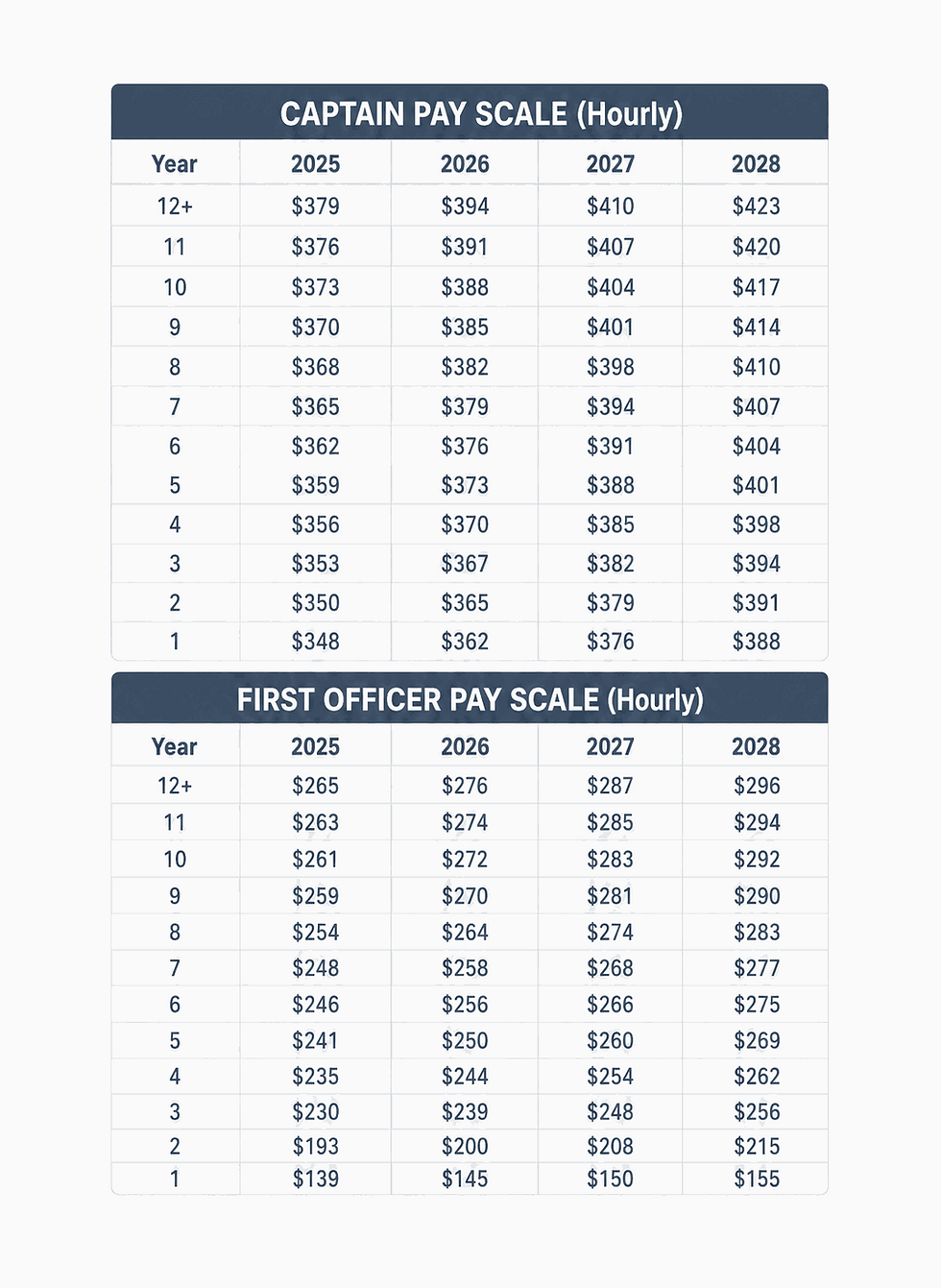
Pay system: Southwest pilots are paid using Trips for Pay (TFP) rather than a standard block-hour pay system.
Monthly guarantee: Lineholders and reserve pilots receive 84 TFP in a 28- or 29-day bid period, 87 TFP in a 30-day bid period, and 89 TFP in a 31-day bid period.
Reserve daily pay: An unassigned normal reserve availability period pays 6 TFP, an early reserve period pays 6.5 TFP, and an unassigned redeye reserve period pays 7 TFP. Once assigned, reserve pilots are paid under the same trip-credit rules as lineholders.
Minimum duty-period credit: Each qualifying duty period generates at least 5 TFP.
Average daily guarantee: Pairings are protected to an average of 6.5 TFP for each domicile day the pairing overlaps.
Duty rig: Pilots receive 1 TFP for every 1.55 hours on duty when the duty rig produces more pay than the scheduled flying.
Trip rig: Pilots receive 1 TFP for every 3.45 hours away from base when the trip rig produces more pay than the scheduled flying.
Deadhead pay: Required domestic and international deadheads receive 100% pay credit.
Premium open time: Company-designated trips may be offered at 150%, 200%, or 300% pay. Voluntary reserve flying outside the reserve block may pay 200%, while qualifying short-notice reserve callouts pay 150%. Inverse assignments and junior assignments pay 200%.
Reassignment pay: Reassigned legs within the original trip footprint pay 150%. Reassigned legs outside the original footprint pay 200%. A late release pays 150% per affected leg, increasing to 200% when the release is more than three hours late.
Holiday pay: Pilots receive 6.5 TFP for qualifying duty, reserve availability, or training during a covered holiday period.
Night override: Flying scheduled to operate between 1:00 a.m. and 5:00 a.m. domicile time receives a 3% pay override. The override also applies to deadheads.
International override: Qualifying flying outside the contiguous United States receives a 3% override. International flying requiring a special-airport qualification or ETOPS receives a 5% override on the applicable leg credit.
Per diem: The 2026 rate is $3.04 per hour domestically and $3.63 per hour internationally.
Retirement contribution: After the first year, Southwest provides an 18% non-elective retirement contribution plus a 2% Market-Based Cash Balance Plan contribution, for a total company-funded retirement contribution of 20% in 2026.
Profit sharing: Southwest’s contractual profit-sharing formula allocates 15% of company earnings before taxes to the plan. Individual payouts depend on company profitability and are not guaranteed.
Sick leave: Sick leave accrues at 10% of a pilot’s straight TFP, with a maximum bank of 1,600 TFP.
Training pay: Qualification training lasting more than seven days generally pays 5 to 6 TFP per day, depending on the training. Continuing qualification training lasting fewer than seven days pays 6.5 TFP per day. Required training travel is paid in addition to the training credit.
Minimum days off: Pilots receive at least 14 days off in a 28- or 29-day bid period, 15 days off in a 30-day period, and 16 days off in a 31-day period.