
The Delta AON Assessment: What to Expect and How to Prepare

A pilot's complete guide to Delta Air Lines' AON online assessment — the full hiring process, a section-by-section breakdown of the test, and exactly how to prep to pass it.
If you're reading this, you probably just opened an email from Delta Pilot Selection telling you that you've been selected to begin the interview process, and that the first step is an online assessment through AON. First — congratulations. That email means two members of Delta's Application Review Team looked at your file and moved you forward. Getting to the AON is not a formality; it's the first real gate in the process, and a lot of qualified pilots stumble here simply because nobody told them what they were walking into.
This article fixes that. I'll walk you through where the AON fits in Delta's overall hiring flow, what the assessment actually measures, a section-by-section breakdown of what you'll see, and a concrete, no-nonsense prep plan — including which companies people in this community actually use.
First, a reality check on timing
The single most common question after the invite email is "When does the actual test link show up?" The honest answer: it varies wildly. Candidates have reported anywhere from the same week to three-plus months between the initial "you've been selected" email and the link to sit the AON. The gap depends on your experience level, who you fly for, hiring demand, and factors nobody outside the recruiting office can see. (If you're wondering how your hours actually stack up against who's getting hired, see what flight time is competitive at Delta.)
So don't panic if you wait. And don't fire off "just checking in" emails every few days — they rarely move anything. Use the wait time to prepare, because once the link lands, you'll typically have a firm deadline.
Where the AON fits in Delta's process
Delta runs a multi-stage pilot hiring pipeline. The Aon is stage one of the interview process — a screen you clear before you ever fly to Atlanta. Here's the full sequence so you can see the terrain ahead:
Initial application — submitted through Delta's pilot career portal.
Application review — each application is read by two members of the Application Review Team.
Interview process — this is where the AON lives. Competitive candidates must pass the AON online assessment, then a panel interview at Delta HQ, and final evaluations to earn a Conditional Job Offer (CJO). At HQ you'll also complete the MMPI-2 (a lengthy standardized personality inventory) and a virtual interview with one of Delta's psychologists.
Pre-employment screenings — drug test, background/TSA fingerprint check, medical, and the rest.
Delta indoctrination — a two-week onboarding into policy and culture.
Wing ceremony — you get your Delta wings with family present.
Training — the FAA-approved Initial Qualification Curricula under Delta's Advanced Qualification Program (AQP).
The key takeaway: the AON is a standalone cognitive-and-personality screen taken from home, well before the human, face-to-face part of the process. Treat it as its own event with its own preparation.
What the AON actually is
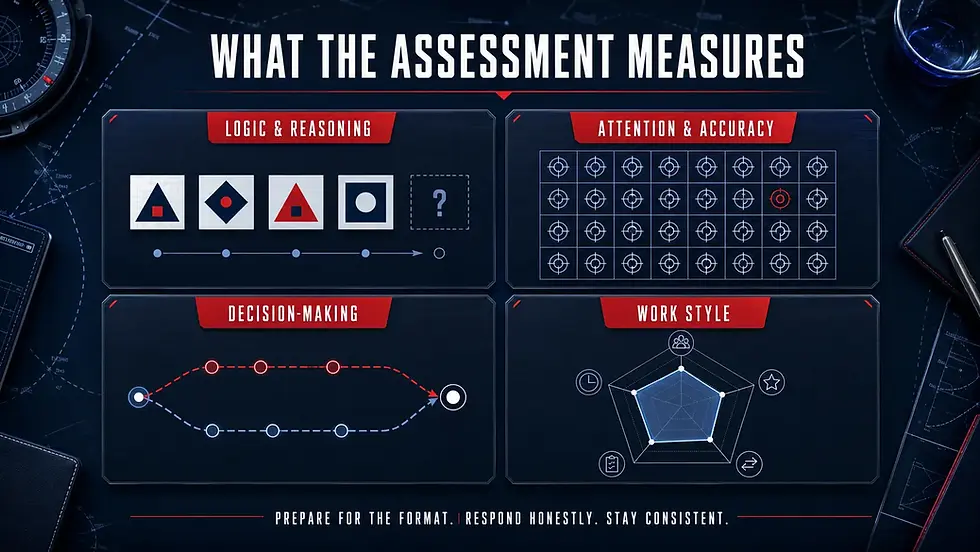
AON (the assessment vendor; you'll also see the underlying test engine referred to as cut-e) builds a suite of short, adaptive, game-like modules that measure how you think and behave under load rather than what aviation facts you've memorized.
Delta's official language describes it as testing "various personality and skill-based competencies," and that's the right way to frame it: part cognitive aptitude battery, part work-style personality questionnaire.
A few logistics worth knowing, drawn from AON's own candidate guidance:
It's unproctored and online. You take it at home on your own computer.
You usually get several days to complete it, and you can do modules on different days — but the deadline in your invitation email is the number that matters. Read it carefully.
Individual sub-tests are timed. Personality questionnaires generally are not. It's normal not to finish every item in the aptitude sections within the limit — the tests are built that way.
The modules are adaptive. Many get harder as you get answers right, so difficulty ramping is a feature, not a sign you're failing.
Integrity is non-negotiable. Having someone else take it for you is grounds for immediate removal from the process. Don't even flirt with it.
Section-by-section: what you'll see
Candidate reports vary — some people describe six modules, others eight — because Delta doesn't hand out the same fixed set to everyone, and AON updates its catalog. But the following components come up consistently. Here's what each one is really testing and how to approach it.
1. Spatial orientation / "Aircraft relative to a navaid" (RMI-style)
You're shown an aircraft and a navigation aid and asked to determine the aircraft's position relative to the station — think radial and bearing relationships, RMI-needle logic. It's testing spatial awareness and basic instrument-picture interpretation.
How to approach it: Don't drown in technical detail. Reduce every question to one plain idea: "Where am I in relation to the station?" Practice visualizing the geometry quickly rather than computing it precisely.
2. Shape Sudoku
A logic-and-pattern module. You're given a grid governed by rules you have to infer, and you fill it in consistently — closer to visual logic than arithmetic. Multiple candidates warn that it ramps up fast, escalating into harder puzzle tiers.
How to approach it: Be methodical, not fast. The most common failure mode here is rushing and breaking your own logic. Identify the rule, then apply it the same way every time.
3. Multitasking / the "fly the airplane" monitoring game
A simulated task where you keep something under control while competing inputs demand attention — a classic prioritization and workload-management exercise. It's the closest thing on the test to a mini flight scenario.
How to approach it: Run your normal cockpit hierarchy — aviate, navigate, communicate. Keep the primary task (control) stable first, then layer in the secondary tasks. They're watching how you manage load, not whether you achieve a perfect score.
4. Auditory reasoning / ATC transmission interpretation
You listen to a clearance or ATC-style transmission and answer based on what you heard. It tests listening accuracy, short-term memory, and processing speed.
How to approach it: This is the one where preparation is mostly setup. Have pen and paper ready and write things down — candidates are blunt that trying to hold it all in your head is how people fail this section. Copy like you'd copy a clearance on the line.
5. Work-based personality / Workplace Behaviors
The personality questionnaire. It probes consistency, judgment, and alignment with the traits Delta associates with professional pilots — honesty, adaptability, openness to feedback, being proactive rather than reactive.
How to approach it: Answer honestly and consistently. These instruments have built-in consistency checks, and "engineered" answers designed to look like an ideal candidate tend to backfire harder than a few honest, imperfect ones. Don't overthink individual items.
How to prepare (a real plan)
There's a genuine debate in the pilot community about how much prep helps. You'll find people who drilled for weeks and passed, people who drilled and failed, and the occasional character who did nothing and sailed through. The truth is somewhere sensible: you can't cram your personality or your reaction time, but you absolutely can remove surprise, and surprise is what sinks people. Familiarity with the interfaces, the timing pressure, and the task types is worth real points.
Practice platforms people actually use
These are third-party, paid services — neither is affiliated with Delta — and quality and value vary, so read current reviews before you buy. The two that actually target the Aon/cut-e assessment Delta uses:
PASS — pilotassessments.com — maps the Delta pilot pipeline explicitly to the Cut-E/AON aptitude and reasoning tests, plus reasoning, math, aviation-English, and personality practice, with a candidate forum and feedback reports. This is the most directly Delta-AON-oriented option.
PilotAptitudeTest.com — simulation-style software built around AON/cut-e-style tasks (spatial, monitoring/hand-eye, math) with performance tracking, worked examples, and explainer walkthroughs.
A grounded way to spend money: pick one of these to get reps on the actual Delta module types, work your weakest sections, and don't overspend chasing marginal gains.
What device should you take it on?
The AON assessment is browser-based (delivered through AON's online portal) and technically runs on a desktop, laptop, or tablet. But device choice isn't neutral — it can genuinely affect your scores on the hands-on modules, so pick deliberately rather than grabbing whatever's closest.
The safe default: a laptop or desktop with a real external mouse. A proper mouse gives you far more control than a laptop trackpad on the spatial and monitoring tasks, where small, precise inputs matter. If you go this route, plug in a mouse — don't rely on the trackpad.
The tablet argument. Some candidates prefer a touch-screen tablet (e.g., an iPad) specifically for the hand-eye/monitoring "fly the airplane" game, because tapping and dragging directly on the screen can feel more intuitive than steering with a mouse. If you're more coordinated on a touch screen than a mouse, this is a legitimate edge worth considering.
Whatever you choose, verify it first. Compatibility can vary with the exact modules Delta sends, so open the sample/practice links from your invitation email on that same device before you start for real. Confirm every task loads and responds correctly. Don't discover a problem mid-assessment.
Bench the phone. A smartphone screen is too small for the visual and multitasking modules. Even if it technically loads, don't take a real attempt on one.
Bottom line: default to a laptop/desktop with a good mouse for precision, consider a touch-screen tablet if you're stronger with touch controls on the monitoring game — and test-drive your choice on the sample links first.
Practical prep that costs nothing
Set up your environment. Quiet room, no interruptions, a reliable computer and a comfortable mouse. Test your hardware and connection before you start.
Have pen and paper on the desk for the auditory/ATC section. This is the highest-leverage free tip in this whole article.
Do modules when you're sharp. You have several days and can split them up — don't grind all of them at 11 p.m. after a redeye. Rest and hydrate; treat it like a checkride.
Rehearse the timing feeling. The point of practice software isn't memorizing answers (the items change) — it's getting comfortable making quick, careful decisions under a clock so the format doesn't rattle you on the day.
For personality: be yourself, consistently. Decide going in that you're answering straight, and then don't second-guess.
After you pass
Clear the AON and you're invited to Delta HQ in Atlanta for the in-person stage: a panel interview, the MMPI-2, a logbook review, and, for successful candidates, a virtual interview with a Delta psychologist. Come with your logbooks organized professionally and every original document Pilot Selection lists in your pre-interview email — showing up missing a required item can force a reschedule.
Handle the logbook review early — it's one of the few interview variables you fully control. Interviewers check your claimed totals against your records, and a messy logbook (paper books, digital exports, years of corrections) turns that check into a stress test. A clean, well-presented one keeps the conversation on you, not your paperwork.
If you want it squared away, PilotAudit.com audits your logbook, prints polished interview logbooks, and offers a complete package tailored to the airline you're interviewing at.
However you do it, walk in with your records buttoned up.
This later stage rewards a different kind of preparation than the AON: STAR-method behavioral answers, deep familiarity with Delta's culture and "Rules of the Road," CRM/situational judgment, the job-knowledge test, and rehearsed answers to common panel questions.
Bottom line
The AON isn't trying to trick you — it's observing how you think, prioritize, and behave under mild pressure. You can't fake it, but you can prepare for it: know the module types, kill the element of surprise with a few honest reps, keep pen and paper handy, protect your test environment, and answer the personality section like the professional you already are. Stay calm, stay consistent, and focus on fundamentals. That's what gets people through.
And if you want the bigger picture of what you're working toward — Delta pay scales, bases, fleet, and current hiring trends — the full Delta Air Lines pilot profile lays it all out in one place.
Good luck — go get the CJO.
Sources & further reading
Delta Air Lines — Pilot Hiring Process & FAQs (official): https://www.delta.com/us/en/careers/pilots/hiring-faqs
AON — Prepare for Your Online Assessment (vendor guidance): https://www.aon.com/en/capabilities/talent-and-rewards/prepare-for-your-online-assessment
This article is an independent guide compiled from Delta's public hiring information, AON's published assessment guidance, and firsthand candidate reports. It is not affiliated with or endorsed by Delta Air Lines or AON. Details of the hiring process change over time — always follow the specific instructions and deadlines in your own invitation email.



Comments