
The American Airlines Logbook Review: A Pilot's Complete Guide to Passing the Interview
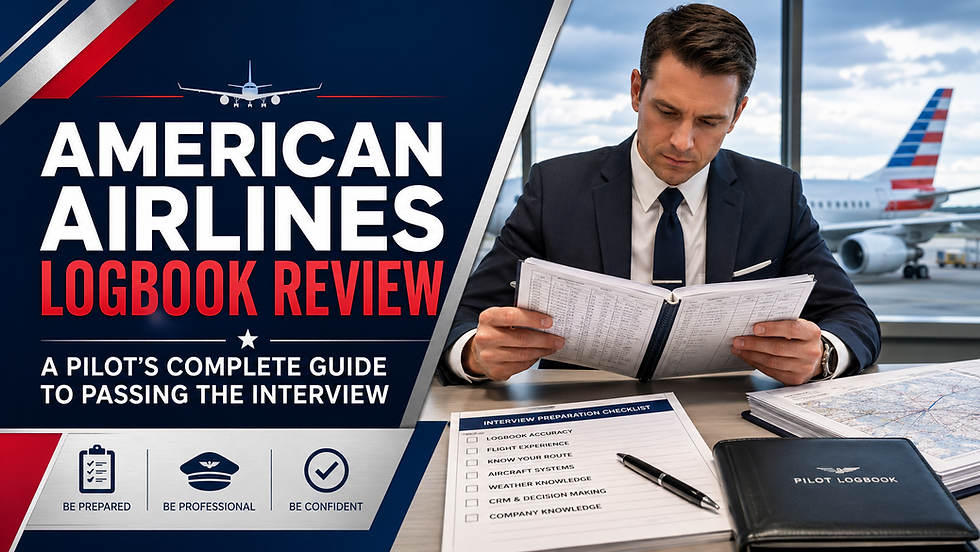
You spent years building the flight time. Don't let a disorganized binder be the thing that costs you a conditional job offer. At American Airlines, the logbook review isn't a casual glance at your totals — it's a documented, standards-driven part of the interview, and the checklist AA sends candidates is stamped, in red, "Compliance required for employment consideration."
This guide breaks down exactly what American Airlines expects when you hand over your records, based on AA's own logbook criteria checklist, plus the mistakes that generate questions and the prep that makes the review effortless. If you have an interview on the calendar, read this before you print a single page.
Why the American Airlines logbook review matters
Every major airline verifies your flight time, but American is known for a thorough, structured records review. The goal on the other side of the table is simple: the reviewer wants to confirm that the hours on your application are real, traceable, and consistent with what's written in your books. A clean, well-organized logbook lets them do that in a couple of minutes and move on. A messy one invites scrutiny, slows everything down, and puts you on the back foot for the rest of the interview.
Before you even get to logbook prep, do your homework on the airline itself — fleet, bases, culture, and the shape of the interview day. A good starting point is the American Airlines pilot profile on Pilot Future, which gives you the context recruiters expect you to walk in with.
What American Airlines requires in your civilian logbook
American's requirements track FAR 14 CFR 61.51, but with a few specifics that trip pilots up. Here's what your civilian records need to show.
Every original logbook, from zero time to your last flight. You must provide all of your original logbooks — not a summary that starts partway through your career. Continuity from the beginning is the expectation.

Complete individual flight entries. Each entry needs the date of flight, departure and destination, aircraft type, registration, PIC/SIC role, and conditions of flight. Multiple legs on the same day can share one line only if they were flown in the same aircraft on the same day.
Page totals and forwarded time on every page. This is the big one. Each page must show its own totals with time carried forward — not just a single grand total at the back of the book. If you're printing a digital logbook, this requirement alone rules out certain print styles.
A signature on every page. American wants a signature on each page, not initials. A dated signature is not required, but the signature is.
All endorsements and primary training/checkride events inside the logbook. Your ratings, endorsements, and checkride records need to live in the books, in written form.
What American Airlines will NOT accept
American's checklist is explicit about formats that are not acceptable as your record of flight time:
Crew expense logs
Thumb drives or flash drives
iPads (an app on a screen is not your submitted logbook)
Spreadsheets
Block time entries
Screenshots
The takeaway: your flight time has to be presented as a proper, printed-and-bound logbook with per-page totals — not a digital file shown on a device or a raw export.
Digital logbooks: how to print and present them for AA
Most pilots today fly with an electronic logbook, and American accepts them — but only when printed and bound correctly.
Print and bind the entire logbook chronologically, with no loose-leaf pages. A three-ring binder is fine. The critical detail is that each page must display totals for every category of flying, page by page, with time carried forward — not just a final tally at the end of the book. Sign each page (again, a signature, not initials; a date isn't required).
Every endorsement, every passed or failed check, and every signed event has to appear in written form in the printed record. Include endorsements for each rating you hold other than your ATP.
A note for popular software: if you use a logbook program that offers a "continuous" print layout, avoid it for American — that style typically omits the page totals and carry-forward totals AA requires. Use a "rows per page" or Jeppesen-style layout with page totals instead.
If you'd rather not wrestle with print settings, margins, and page-total layouts the night before your interview, a dedicated pilot logbook printing service will take your digital export and produce a clean, professionally bound book formatted to meet these requirements — including per-page totals and a signature line on every page — so what you hand the reviewer is already interview-ready.
If you transferred your time from paper into a newer or electronic logbook, bring both copies, and make sure the totals in your logbooks match the hours on your application exactly. Show continuity and forwarded time between books — do not start a subsequent logbook at zero.
Military records: what to bring by branch
American does not want you to disassemble your official military folder. Bring it intact, and add a clean civilian-style summary that a reviewer unfamiliar with military records can follow.
Air Force — Bring your green folder: Flight Evaluation Folder (Form 942 with associated Form 8s), Flying History Report including ARMS/ARTEMIS with leg detail, Individual Data Summary, Individual Flight Record Report, and your Section 1 Record of Evaluation showing Qualification Level 1 or 2 (if Q3, include the reason for downgrade in Section 2). Times must be totaled, forwarded, and signed on each page — not loose leaf. Remove all "OTHER" time from your totals, and hold an unrestricted ATP.
Army — Bring your brown folder (if prior to digital records in CAFRS): Flight Time Summary (DA Form 759), DA Form 7122 or 7122-R, and a civilian logbook if applicable. Rotary-wing time must be separated from total time on the application. Unrestricted ATP required.
Navy / Marines / Coast Guard — Bring your Aviators Logbook "Blue Books" with total time and PIC that match your AA application (note: "Special Crew Time" does not count toward total time), your NATOPS folder and Qualification page, your Aviators Incident and Mishap pages, and a civilian logbook if applicable. Unrestricted ATP required.
A key point for all military applicants: PIC Turbine is not logged as a cruise pilot. Only the Captain or Aircraft Commander, while at the controls, may log PIC.
Foreign logbooks
If you hold foreign logbooks, bring all originals — including primary logs, certifications, endorsements, and failures — showing continuity of time without gaps. Every flight must be individually logged; a bulk certification of flight time is not acceptable, and no certificates of time are accepted in place of the records. Pages and times should be checked for continuity, totaled, signed, and dated.
Lost, stolen, damaged, or destroyed logbooks
If some of your original records are gone, American evaluates these situations case by case, but there's a minimum starting point.
For lost or stolen logbooks, you'll need a certified, complete FAA Form 8710 airman certification file (a certified copy — not a plain photocopy and not an IACRA printout), any available flight-school documentation such as payment records or certificates, and a personal disclosure page that is signed, dated, and notarized. If the books were stolen, add a police report and/or an insurance claim that names the logbook(s).
For damaged or destroyed logbooks, provide the certified complete 8710 file, an insurance or police report naming the logbook(s), the remains if possible (or clear images), and a letter of explanation.
To request the FAA Form 8710, submit an AC 8060-68 request and be sure to check the "certified copy" box. Once you receive a certified 8710, the first line in your new logbook should summarize all the totals from the 8710 as if it were a flight, with a remark reading "time forward from 8710 dated DD/MM/YYYY."
Disclosing training failures, checkride busts, and incidents
This is where honesty is non-negotiable. American wants to know about any removal from flight status, any unsatisfactory flight training, and any failed written exam or checkride — provided on the application questionnaire with a date (month/year) and an explanation. The same goes for a lost medical, an aircraft incident or accident, or any investigation.
The standard AA applies is blunt: if it's in your logbook, you must disclose it — yes, even a private-pilot unsatisfactory or a written test failure from 20-plus years ago. Undisclosed events can result in application denial. A single old bust, disclosed and briefly explained, is a manageable footnote. The same bust discovered undisclosed in your books is a credibility problem.
Bonus points: how to make your logbook stand out
Beyond the minimums, American's own guidance lists things that help you present well:
Include a flight time summary sheet up front.
Break out PIC and PIC Turbine into their own columns.
Add tabs for milestones — endorsements, rating events (passed and failed), and re-tests — so a reviewer can flip straight to what they need.
A few more practical tips from AA's checklist: combine multiple legs on one line only when they're the same day and same aircraft registration; total and forward all columns on every page separately; remember that simulator time is not logged toward total time; verify continuity across all logbooks with no missing time and no bulk entries; and if you're a helicopter pilot, keep fixed-wing and rotary-wing time separate and do not add RW time to your total time.
Common mistakes that trigger questions

Most avoidable logbook problems fall into a handful of buckets:
Missing page totals on a printed digital logbook (the "continuous" layout trap).
Initials instead of full signatures on each page.
Totals that don't match the application — even a small mismatch invites a line-by-line walk.
Starting a new logbook at zero instead of forwarding time.
Undisclosed old failures or incidents that show up in the books.
Math errors that compounded across years of paper carry-forwards.
Any one of these turns a two-minute review into a twenty-minute interrogation.
Should you use a professional audit or prep service?
You can absolutely prepare your logbook yourself — the requirements above are the whole picture. But if your records are messy, span paper and multiple digital platforms, include military time, or you simply don't want to gamble your interview on your own formatting, a professional set of eyes is worth considering.
A professional pilot logbook audit reviews your times, totals, and categories and flags discrepancies before a recruiter ever sees them — the kind of small carry-forward errors and category mismatches that are easy to miss in your own book and awkward to explain across the table.
If your interview is close, an airline interview logbook prep package goes a step further: it formats and prints your digital logbook into a clean, bound, interview-ready binder built to match the specific carrier you're interviewing with — including the per-page totals and layout American requires. Showing up with records that are already organized the way the reviewer expects is one of the simplest ways to take pressure off interview day.
American Airlines logbook review FAQ
Does American Airlines really grade your logbook? American treats the logbook review as a compliance step tied to employment consideration, and a clean presentation directly affects how smoothly your records review goes. Regardless of exactly how it's scored, the practical reality is that a disorganized logbook works against you and an organized one works for you.
Can I show my logbook on an iPad at the American Airlines interview? No. American's checklist specifically lists iPads, screenshots, spreadsheets, and flash drives as not acceptable. You need a printed, bound logbook with per-page totals.
Do I need to sign every page of a printed digital logbook? Yes. American requires a signature (not initials) on each page. A dated signature is not required.
What if I lost one of my logbooks? American evaluates lost, stolen, damaged, and destroyed records case by case, but you'll generally need a certified complete FAA 8710 file plus supporting documentation (and a police or insurance report if stolen or destroyed). Request the 8710 via an AC 8060-68 request and check the certified-copy box.
Should I disclose a checkride failure from years ago? Yes. If it appears in your logbook, disclose it on the application questionnaire with a date and explanation — even a decades-old private-pilot unsat. Undisclosed events can lead to application denial.
Who do I contact at American with logbook questions? American directs candidates to email Pilot.Recruitment@aa.com with "LOGBOOK DATA" in the subject line.
This article summarizes American Airlines' published logbook criteria for pilot candidates (Rev. 3.7, November 2025) and general interview-prep best practices. Requirements change — always confirm the current instructions in your official AA interview packet before finalizing your logbook.



Comments